
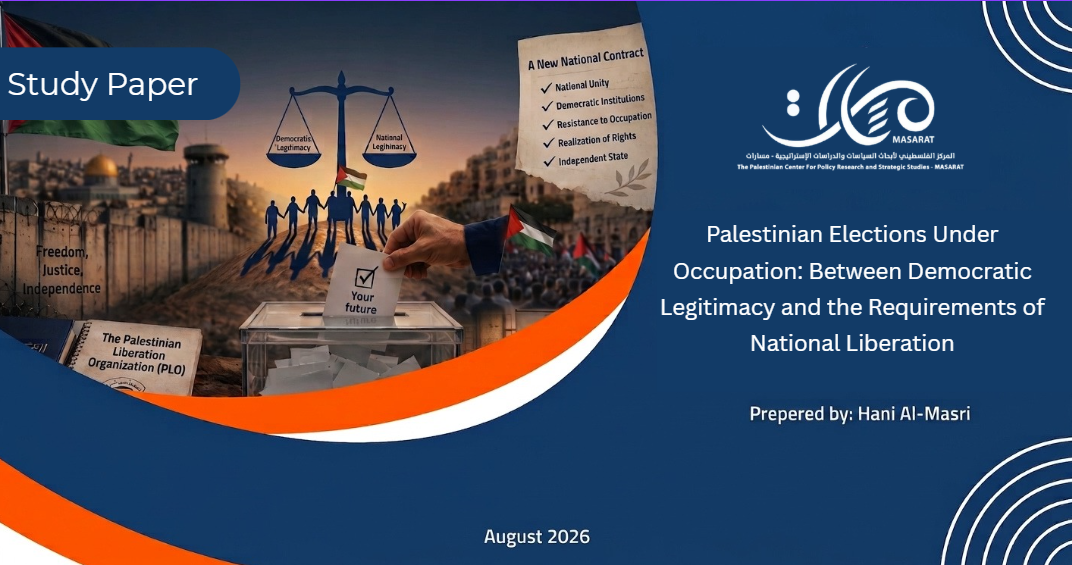

President Mahmoud Abbas’s announcement of holding Palestinian presidential and legislative elections has revived questions about the Authority’s need to survive, to renew its legitimacy, to overcome the deep impasse it is experiencing, and to prepare for the coming stage,one marked by major stirrings that could lead to local, regional, and international changes.
The announcement came against the backdrop of a misjudgment,namely, that Hamas and the rest of the factions within the framework of the resistance would not participate, whether because of the political restrictions imposed under the elections law, or because of the possibility of being barred from participation by the occupation, the American administration, and other influential parties.
Yet the announcement reopened an old debate that is renewed whenever this entitlement is raised: Do elections represent a way out of the Palestinian crisis, or are they part of the solution, or might they turn into a means of reproducing and deepening the crisis?
From here, reducing democracy to merely organizing periodic elections strays from the essence of the matter. Elections are not an end in themselves, but rather one of the tools of democracy; and democracy is not merely a mechanism for choosing rulers, but an integrated system founded on the social contract, the rule of law, the independence of the judiciary, the separation of powers, the guarantee of public freedoms and human rights, respect for election results, and the peaceful rotation of power.
Many experiences have proven that elections may be held under authoritarian regimes, or under occupation, or amid sharp divisions, without necessarily leading to real change,and especially not to the establishment of a democratic system. Democracy itself is not a single model; political literature has developed different formulas, from competitive democracy to consociational democracy and power-sharing, especially in divided societies or those emerging from conflict, where resorting to majority rule alone may deepen division rather than transcend it.
These questions acquire doubled importance in the Palestinian case, because Palestinians do not live in an independent, sovereign state, but rather under a settler-colonial, replacement occupation that controls the land, the borders, the crossings, the population registry, and the economy, and possesses the ability to arrest candidates and voters, to prevent elections from being held in large parts of the Palestinian territories, or to nullify their results if they conflict with its interests.
Therefore, the real debate should not revolve only around participation or boycott, but around the function of elections and their political and national conditions, and the extent of their capacity to serve the project of national liberation, rather than turning into a means of reproducing the Authority in its functional role of managing the population on behalf of the occupation.
To read the full study, please press Read or Download buttons under the picture.