
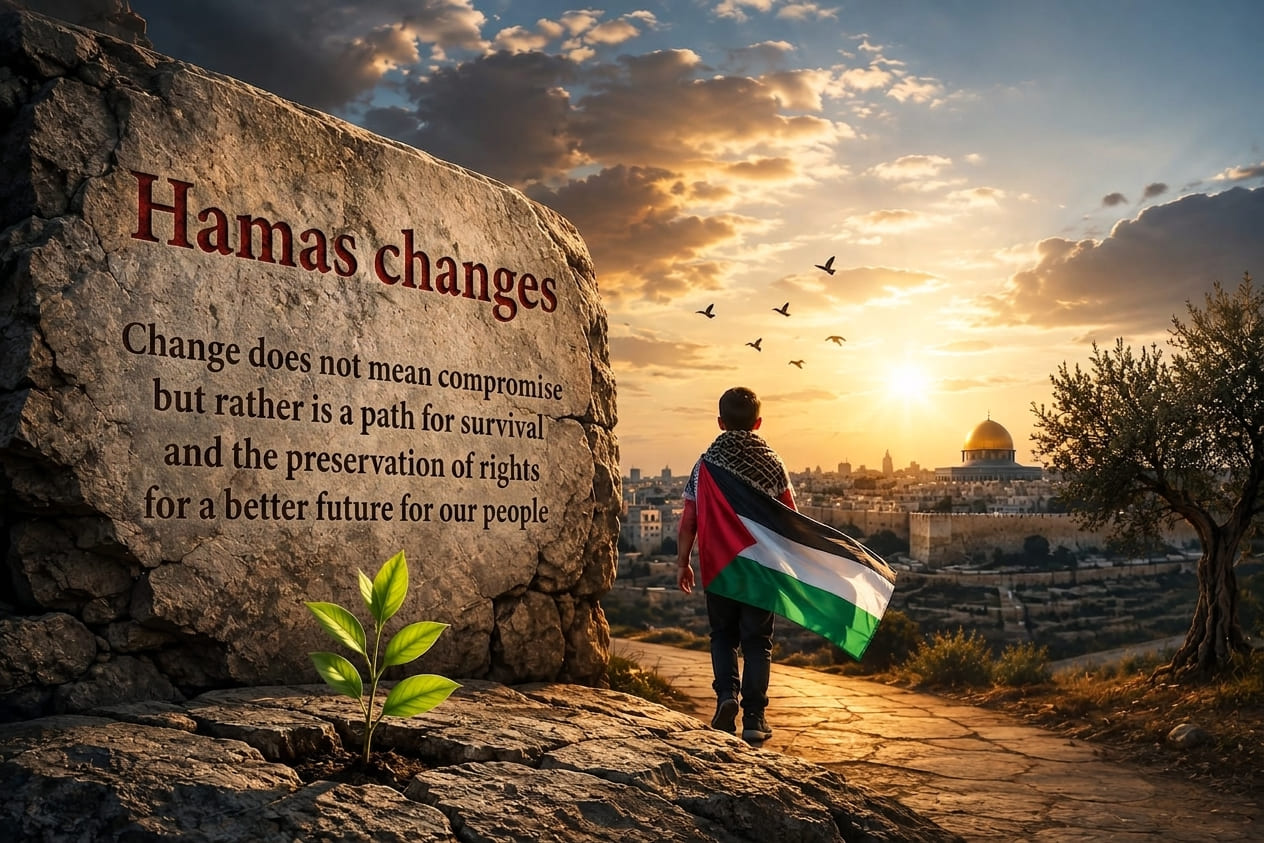

In a new analysis titled “Hamas Is Changing,” Palestinian political analyst Hani Almasri argues that Hamas is once again undergoing a significant political transformation, much as it did two decades ago,and that the movement’s latest shifts should be understood in the context of its struggle to survive politically and protect the Palestinian population amid unprecedented conditions.
Almasri recalls that he wrote a paper with the same title in 2005, arguing that Hamas had begun a major shift in its political approach following its acceptance of the Cairo Declaration in March of that year. The declaration included a number of provisions indicating Hamas’s willingness to join the Palestine Liberation Organization (PLO) and participate in the Palestinian Authority. That shift became clearer when Hamas took part in the local elections held later that year and then in the legislative elections in 2006.
At the time, Almasri notes, Hamas had previously rejected joining the PLO, despite what he describes as a generous offer from the late Palestinian leader Yasser Arafat. Instead, the movement had sought to establish an alternative or parallel organization to the PLO. It had also boycotted the first legislative elections, viewing them as a product of the Oslo Accords, which Hamas opposed and sought to overturn.
Against that background, Almasri argues, Hamas’s decision to enter the PLO and the Palestinian Authority without making such participation conditional on changing the political approach or overturning Oslo represented a major shift.
But, he stresses, this transformation did not happen in a vacuum.
Why Hamas changed then
Almasri identifies several factors behind Hamas’s earlier transformation.
First, he writes, Hamas came to recognize that creating an alternative or parallel organization to the PLO was extraordinarily difficult, if not impossible, because it ran up against an entrenched Arab and international consensus recognizing the PLO as the sole legitimate representative of the Palestinian people.
“Hamas therefore chose to work to change the PLO from within, rather than seek to create an alternative framework,” he writes.
Second, Hamas believed that Fatah had been significantly weakened following Arafat’s assassination, the failure of the 2000 Camp David summit, and the collapse of the political track on which the PLO leadership had placed its bets. This, Almasri argues, led Hamas to believe that it could become a full partner in the Palestinian political system and perhaps gradually replace Fatah as the leading force in the national project.
The movement was also encouraged, he says, by changes in US policy following the September 11, 2001 attacks. The administration of George W. Bush adopted an approach that, among other things, viewed regional stability as requiring changes to regimes seen as creating an environment conducive to extremism, while promoting what was then described as “moderate Islam” in opposition to “extremist Islam.”
Within this broader context, Almasri argues, Hamas came to treat Oslo as though it were already dead.
But, he cautions, “Oslo died on the Israeli side, but it remained,and remains,alive and kicking on the Palestinian side.”
The clearest evidence, he says, is the continued existence of the Palestinian Authority and its adherence to the political, economic and security obligations arising from the Oslo framework.
Israeli governments, beginning after the assassination of Prime Minister Yitzhak Rabin, gradually and then almost completely abandoned many of the Israeli commitments contained in Oslo, Almasri writes. Yet successive Israeli governments, including the current government, which he describes as the most extreme in Israel’s history, have never formally buried or cancelled the agreement.
According to Almasri, this is because doing so would force Israel to assume full responsibility for the consequences while allowing it to retain the Palestinian obligations embedded in the agreement.
“Hamas does not change”
Almasri recalls an episode that he considers particularly revealing about the debate over Hamas’s political evolution.
The Islamic Women’s Association had invited him to present his 2005 paper on Hamas’s transformation at a large conference attended by many Hamas leaders, cadres and supporters at the Martyr Zafir al-Masri Auditorium at An-Najah National University.
Some young members of the Islamic Bloc reacted angrily, Almasri recalls, chanting and shouting that “Hamas is steadfast and does not change.”
Sheikh Hassan Yousef was sitting beside him. According to Almasri, Yousef turned to him and said that Hamas does not change.
Almasri replied that change is simply a law of life.
“Only inanimate objects do not change,” he recalls telling him. “Those who do not change are overtaken by events.”
For Almasri, this exchange captures a broader reality about political movements: their commitment to their goals does not mean that their methods, policies or political calculations remain frozen in time.
Any political movement, he argues, is primarily concerned with achieving its objectives and implementing its program. But political survival also matters,“perhaps even before that.”
“Changes, challenges, risks, and sometimes opportunities may force political movements to change, because change becomes the only path to survival and the achievement of their goals,” he writes.
And, in his view, “this is exactly what is happening with Hamas at this stage.”
Hamas’s latest transformation
Almasri argues that Hamas’s recent positions must be understood against the backdrop of the devastating war in Gaza and the extreme imbalance of power facing the Palestinians.
He says Hamas ultimately agreed to the Trump plan, albeit gradually, because it saw acceptance as the only available way out of the war of extermination in Gaza.
Following the adoption of UN Security Council Resolution 2803, he argues, the plan acquired international backing and became the principal political framework for ending the war.
Hamas subsequently agreed to the 15-point proposal, although Israel later backed away from its commitments, while Hamas nevertheless secured US cover despite the plan being “American through and through,” according to Almasri.
He also points to Hamas’s willingness to disarm under an arrangement involving the storage and eventual handover of its weapons to the administrative committee, relinquish control of the Gaza Strip, and transform itself into a political party.
In Almasri’s reading, Hamas is prepared to make these concessions in exchange for an end to the war, a simultaneous Israeli withdrawal and implementation of the remaining provisions of the plan, above all, reconstruction.
He argues that there is little basis for anyone to lecture Hamas, other Palestinian factions, or the Palestinian leadership and Authority about why they accepted the Trump plan and the administrative committee affiliated with the Board of Peace.
Almasri describes that body in stark terms, calling it “in practice, a colonial trusteeship council” that overrides, and could ultimately replace, the Palestinian political system in all its various components.
The limits of Palestinian leverage
For Almasri, the scale of the current crisis makes the reasons behind these decisions difficult to ignore.
More than 1,500 Palestinians have been killed since the ceasefire in October, he notes, while Israeli forces have continued to commit violations, including expanding the territory under Israeli control inside Gaza to approximately 70 percent.
The absence of any Palestinian response capable of stopping these violations, he argues, is itself a devastating measure of how far the Palestinian side’s weakness and political impasse have gone.
But recognizing these realities, Almasri insists, should not mean abandoning difficult questions.
“On the contrary,” he writes, “what is required today is deep dialogue, a courageous review, and frank accountability and criticism” over how Palestinians arrived at this point.
The questions, he says, should include why the Palestinian side has reached such a low point in the balance of power and its ability to exert influence, and,most importantly,how it can escape this predicament and build a better Palestinian political reality.
“Yes, Hamas is changing”
Almasri is unequivocal about his central argument.
“Yes, Hamas is changing,” he writes. “It changed in the past, and it is changing now as well.”
But he makes an important distinction: change, in his view, should not mean Hamas “changing its skin” or abandoning its identity, program or role.
At the same time, he argues that sufficient change has become a necessity, because refusing to change could put Hamas’s own political and organizational survival at risk.
For Almasri, the most consequential change required of Hamas, and of other Palestinian resistance factions, is to halt armed resistance at this stage.
He argues that ending armed resistance has become an Israeli condition backed by regional and international actors, and that continuing armed confrontation under the current balance of power could provide Israel with a pretext to prolong the war, deepen Palestinian suffering, delay Israeli withdrawal and obstruct the reconstruction of Gaza.
Reconstruction, he stresses, must be “the priority of priorities” in order to prevent further displacement and forced migration.
Yet Almasri draws a clear line between suspending armed resistance under current circumstances and abandoning the Palestinian national project.
Armed resistance, he argues, can be halted without giving up the national project, which he says itself needs to be reformulated and grounded in national consensus.
Nor, he adds, should Palestinians relinquish the right to resistance in all its forms or commit themselves to never resorting to armed resistance in the future if circumstances change and make it necessary.
Most importantly, he warns against condemning resistance retroactively.
Such a move, he argues, would repeat the experience of Oslo and its annexes, whereby a political decision taken under specific circumstances can gradually become a permanent renunciation of rights and principles.
Change without surrender
For Almasri, the broader lesson extends well beyond Hamas.
“Political movements do not exist in a vacuum, nor do they operate under fixed conditions,” he writes. They must adapt to changing circumstances in order to protect their people and pursue their objectives.
But there is a line that must not be crossed.
“Adaptation should not turn into surrender,” Almasri argues, “and change should not mean giving up rights.”
Nor, he warns, should the pursuit of political survival become dependent on “the poisonous gamble” of relying on US policy, an approach he says cannot be trusted and must never take precedence over the survival of the Palestinian people, their cause and their rights.
Ultimately, Almasri argues that the transformation cannot stop with Hamas.
“Hamas must change, Fatah must change, the other Palestinian forces must change, and the entire Palestinian political system must change.”
What is needed, he says, is the emergence of new movements, political currents, parties and forms of activism capable of generating a genuine political revival.
The goal should be to move beyond merely managing division and crisis toward developing a comprehensive vision, from which appropriate strategies can emerge alongside the creation of “one national leadership” capable of protecting Palestinian people, rights and interests.
The Palestinians, he argues, must regain the initiative rather than continue merely adapting to what others impose upon them.
Almasri closes by drawing a distinction that lies at the heart of his argument:
“Change is not the opposite of steadfastness.”
Remaining steadfast in one’s goals and rights, he says, does not mean remaining rigid in one’s methods and policies.
“This is the issue that should be at the heart of the real debate today.”
Note: This is not a literal translation of the original document. It is an English adaptation that conveys all of the original article’s ideas and follows its argument and sequence. Direct quotations are taken from the original article.