
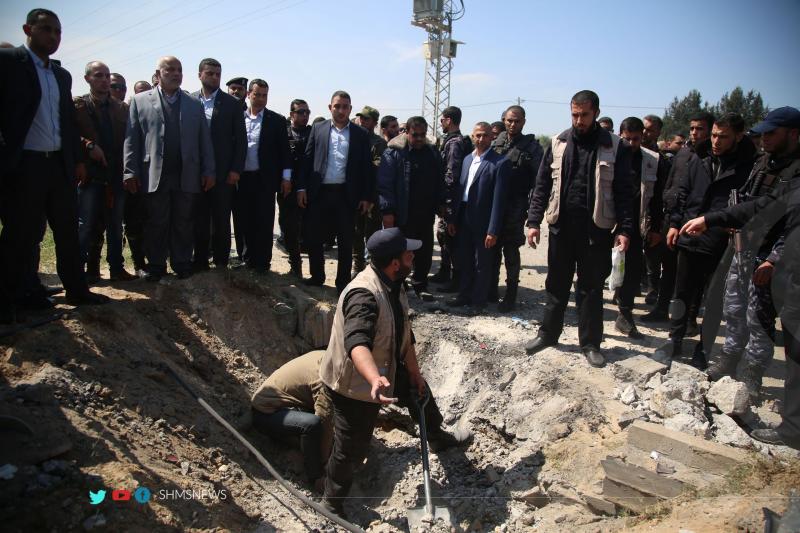
The crime of blowing up the he prime minister’s convoy initially created the impression that efforts to successfully conclude the new round of reconciliation attempts were doomed, and that things would regress to the starting point, that is, to what they were before Egyptian auspices.
That expectation was strengthened by several provocative statements in which accusations were exchanged, and those making them imagined that their accusations were correct. They warned that following the crime, things would never return to the way they had been before. This created the impression that extraordinary decisions could be taken, amidst claims and counter claims about those who committed the deed. The first claim was that the perpetrators belong to an extremist wing of Hamas, and the counter claim was that they belong to the one of the Palestinian Authority’s security agencies.
However, once the dust settled and wiser thinking prevailed, all parties became increasingly aware, under continuous Egyptian pressure, that the reconciliation process must proceed, even though it is nominal.
In any case, the crime constituted a warning signal as to the chaos, anarchy and in-fighting that could occur if the situation is not dealt with. It also strongly focused attention on the issue of security, propelling it to the top of the agenda, after it had been pushed to a later stage as part of efforts to empower the government. Those efforts began within the civilian administration, but remain confined to a vicious circle about what comes first: fully empowering the government, including to collect money for the ministry of finance; or committing to giving advance salary payments to civil servants as a first step towards confirming their appointments and subsequently paying their salaries as part of a process to pay all employees, including those working for security agencies.
We emphasise what we have previously said, that it is necessary to agree over the security portfolio in all of its aspects and to begin implementing that agreement as early as possible, because postponing this is a sure recipe for failure. The national unity government fell after the Mecca Agreement of February 2007 over differences over who would oversee security. The minister of interior was unable to exercise his authority over the security services that were supposed to be answerable to him, prompting him to resign and causing the government of national unity to collapse.
In this context of the importance of security, the national unity document produced by the Masarat Centre in 2016 as part of the dialogue and initiatives undertaken to end the division and regain national unity emphasised the need to implement the clauses of the Cairo Agreement as one comprehensive package that includes: the government, the PLO, security, elections and societal reconciliation. The document also added the issues of the political programme and the principles for partnership.
In that context, it is not possible to make progress on empowering the government while postponing agreement on how to deal with the issues of resistance, negotiations, the political process, the Trump deal, etc. It is also not possible to empower the government unless it has full control of all sectors, particularly security. By the same token, Hamas cannot totally give up governance, let alone the government, without a guarantee that it will become a partner in the Palestinian Authority and the PLO.
Hence, the issue of implementing the contents of the Cairo agreement on restructuring, updating, reforming and activating the security services along nationalist and professional lines, rather than on partisan lines takes on significant importance.
One of the recommendations of Masarat Centre’s “Programme for Reforming and Unifying the Palestinian Security Sector” was that it is difficult to achieve a genuine reconciliation without formulating Palestinian security policies that are consensual and that will lead to the establishment of a unified leadership of the security establishment that is answerable to the highest political authority. Such a unified leadership would help formulate a unified vision on restructuring the security establishment in a manner that is commensurate with Palestinian security needs.
This cannot be achieved unless the security agencies become national and professional in the West Bank and the Gaza Strip. Its members, cadres and leaders should, in keeping with relevant Palestinian laws, not belong to this or that faction. At present, the factions, in particular Fatah and Hamas, continue to dominate and control the security agencies in the West Bank and Gaza.
The continuation of this situation leads to a lack of separation between the National Authority – and the security agencies in particular – and political parties. This is a sure recipe for turning every basic disagreement amongst the factions into a fight. However, if the security agencies are subject to the law and to unified national institutions, and if they safeguard the interests of the people rather than of the factions, things will be different, because disagreements will be resolved within legitimate political frameworks in a peaceful and democratic manner.
The above-mentioned programme also recommended starting to rebuild the police apparatus in the West Bank and Gaza and formulating the principles and standards for doing so within three months, subsequently spreading that experience to all services.
The existing amalgamation of the security agencies and the factions arises from the nature of the phase that the Palestinian people are experiencing and the fact that the factions are a national liberation movement that has the right to resist occupation by all means recognised by international law. It has not been understood that the establishment of the Palestinian Authority has resulted in a degree of overlap between the national liberation phase and the requirements of building the Authority. The latter requires a separation between the security agencies and the factions.
The Oslo Accord, the programme of arriving at a political solution that guarantees a minimum of Palestinian rights through negotiations, reliance on the international community, offering concessions and proving good intentions are part of a process that has reached a dead end. The Palestinian Authority therefore urgently needs to change its nature, its functions and its commitments so that it becomes a tool that serves the PLO and the national programme. This can be achieved through a cumulative process, but it must begin and be completed.
Once the Palestinian Authority is altered on the above basis, the slogans of “one Authority” and “one armed front” can and must be implemented if there is a single unified leadership that represents the entire political and social spectrum.
As for the arms of the resistance, another arrangement must be established that corresponds to the right of the Palestinian people under occupation to resist and that is appropriate for each region and the special circumstances of each Palestinian community. What is appropriate for the West Bank, which is under direct occupation and parts of which are subject to daily assaults, is not appropriate for the Gaza Strip, which is occupied through siege and aggression. Hence, the resistance has no military wings in the West Bank, whereas such wings have been allowed to exist in Gaza, where we saw how the resistance prevented the occupation’s three assaults from achieving their objectives, despite the high price of doing so.
Dismantling the military wings of the resistance, which were supposedly set up for the purpose of liberation, is not a reasonable solution. Those wings should remain in place as long as liberation and a political settlement are not imminent.
This, of course, does not justify using the military wings in internal conflicts and rivalries as tools to promote the interests of power centres, or of one faction or another. This, as we have seen, puts resistance in the service of the Authority, rather than the opposite.
The military wings can be dealt with in accordance with the contents of the national détente document or any similar formulation. The détente document calls for “establishing a unified resistance front called the Palestinian Resistance Front to lead and wage resistance against occupation, unifying and coordinating resistance and action to define a unified political reference for that front.”
To sum up, the crime of blowing up the prime minister’s convoy calls for changing the course of current reconciliation efforts, so that it avoids the logic of winners and losers. That means an outcome that sees all parties are winners. The process should not be limited to enabling the government and prioritising the civilian aspect. Rather, the process should progress along several parallel paths, although they need not be exactly simultaneous, that should include the national programme, the Authority/state, the PLO and elections. Security and meeting people’s daily living needs, civil rights and the requirements for people’s steadfastness should be urgent priorities that cannot be postponed.