
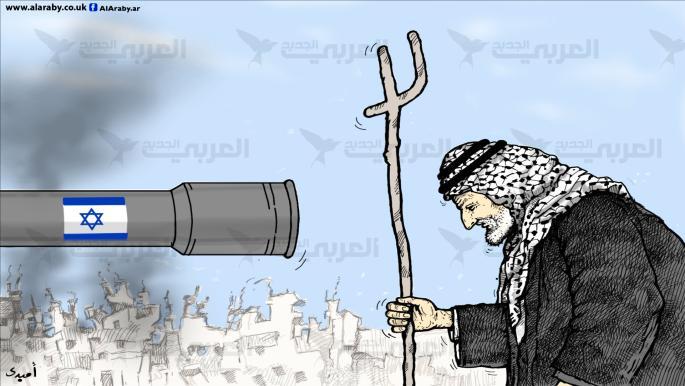

Mr. Hani Al-Masri argues that it is impossible to anticipate the trajectory of 2026 without first stopping at the “heavy ending” of 2025, which closed on what he describes as “one of the worst moments in Palestinian political history.” What emerged, he says, was an extremely dangerous reality, crowned by collective Palestinian acceptance of the Trump Plan. This plan did not merely blame Palestinians for what happened; if implemented, it would in practice place them under a system of colonial tutelage covered by international legitimacy.
The plan, Al-Masri explains, deliberately marginalized Palestinian political representation. It targeted the dismantling of the de facto authority in Gaza while at the same time preventing the return of the Palestinian Authority, subjecting it instead to a test of “reform” whose criteria are defined by Washington and Tel Aviv. Under a massive imbalance of power, rejecting the plan was almost impossible, which opened the door to what he calls the central question: how did the Palestinians reach this dead end, was it inevitable, and how can they get out of it?
What happened, Al-Masri stresses, was not an isolated event. It was the product of the same balance of power, the same actors, and the same structures. That is why the most likely scenario for 2026 is the continuation of the same path, perhaps in an even worse form, through an attempt to translate human extermination into political extermination aimed at uprooting the Palestinian cause altogether. This, he warns, could succeed, at least temporarily, unless fundamental changes occur, especially on the Palestinian side, that are capable of reversing this trajectory.
Among the key shifts already taking shape at the start of the new year, Al-Masri points to the United States’ open return to an imperial logic, with the crude revival of the Monroe Doctrine in Latin America. He cites the kidnapping of Venezuelan president Nicolás Maduro and his wife as a striking example, accompanied by unprecedented American rhetoric that openly legitimizes piracy and the seizure of other countries’ resources by force. Trump, he notes, “did not mince words” in declaring that Venezuelan oil was the target, threatening Latin American countries and others with the same fate if they fail to submit to U.S. will.
“The second phase of Trump’s plan for Gaza will not be implemented as written; it will be re-engineered to serve Israeli objectives, ensuring that the risks of genocide, ethnic cleansing, displacement, annexation, and settlement remain firmly in place”
In this global context, Al-Masri says, the second phase of the Trump plan for Gaza will not be implemented as written. Instead, it will be re-engineered to serve Israeli objectives, meaning that the dangers of genocide, ethnic cleansing, displacement, annexation, and settlement will remain, just as they did in the first phase.
This behavior, he continues, reflects a dangerous transformation in the international system, in which international law and the UN Charter are being abandoned altogether in favor of the law of the jungle. With the return of imperial rivalry, every major power is seeking to dominate its “vital sphere.” China is expected to expand its military presence to protect its interests and supply chains and may reopen the Taiwan file, which it considers part of China. Russia will continue its war in Ukraine and may aspire to rebuild its Soviet sphere, encouraging others to follow the same path. In this climate, the Middle East is one of the region’s most likely to explode, given the intense competition between several regional projects: Iranian, Turkish, and Israeli.
But Al-Masri draws a decisive distinction. The Israeli colonial project, he says, is fundamentally different. It aims to redraw and dominate the entire Middle East through direct military expansion, the imposition of buffer and “safe” zones, and the continued fragmentation of the region under the pretext of “protecting minorities” and encouraging every kind of ethnic, sectarian, and nationalist division, so that no viable Arab regional system can emerge. For this reason, Israel is the party most prepared to benefit from global chaos.
Since October 7, 2023, Israel has pursued what he calls an unprecedented policy of aggressive expansion, which is expected to intensify in 2026 with full American backing. The goal is clear: to invest more than two years of genocide and total destruction in Gaza in order to achieve a political breakthrough, namely, liquidating the Palestinian cause and imposing a new Middle East by force.
On the ground, Al-Masri expects a sharp escalation, especially in the West Bank, through the acceleration of annexation and displacement policies and the transformation of what remains of Palestinian land into population enclaves under an apartheid system. This puts the West Bank “in the eye of the storm” in 2026, with creeping de facto annexation likely to be turned into formal legal annexation, particularly in Area C.
In Gaza, too, the second phase of the Trump plan will be reshaped to fit Israeli goals, leaving intact the risks of genocide, ethnic cleansing, displacement, annexation, and settlement, just as in the first phase, when the resistance respected the terms while Israel continued its violations and aggression. Netanyahu’s government, Al-Masri says, will work to deepen Gaza’s internal division, prevent any international force from limiting the army’s freedom of action, and empty the so-called Peace Council and its tools, including the Palestinian technocratic committee, of any national content, turning them into instruments serving Israeli objectives under an American trusteeship with international legitimacy.
Limited reconstruction and selective improvements in living conditions will be used as tools to break Palestinian will, disarm the resistance, and push the population toward internal displacement as a prelude to external emigration. Netanyahu’s government, he warns, will obstruct any serious reconstruction because real rebuilding would block forced displacement.
This trajectory becomes even more dangerous as Israel enters an election year in which far-right forces compete over who can be more extreme, amid a broad Israeli consensus rejecting a Palestinian state and denying Palestinian national rights. Even if the government’s shape changes, Al-Masri sees no real Israeli partner for peace. Instead, a new political track may emerge that revives the “Deal of the Century” in an even worse form, or reproduces Oslo in a more distorted version: a Palestinian entity that merely covers up an apartheid state across all of historic Palestine—disconnected population enclaves in parts of the West Bank and Gaza, called a “state” without Jerusalem, without refugee return, without sovereignty or real substance, masking the reality of apartheid.
“It is clear,” Al-Masri insists, “that Israel, not Iran, is the danger to the region’s security and stability—and if Iran is defeated, Israel’s danger will only grow.”
By contrast, he says, regional powers like Iran and Turkey have belonged to the region for thousands of years and seek to defend themselves and preserve their influence within their vital spheres. Whatever threats they pose to Arab societies, those threats are not existential and can be managed through political arrangements. Israel’s threat, however, is existential.
For this reason, Al-Masri calls for the possibility, and necessity, of building a regional Arab security system, similar to what occurred between Saudi Arabia and Pakistan or in the Saudi-Iranian meeting in Beijing. He notes that the group of eight states, working with international and regional partners, including the Saudi-French initiative for a two-state solution, succeeded in stopping the genocide but failed to end the war or prevent Israel from keeping the threat of renewed war alive. They also managed to insert talk of a Palestinian state and self-determination into the Trump plan and a related Security Council resolution, but only as a conditional possibility tied to “Palestinian reforms” whose standards are controlled by Israel.
These actors, he adds, also succeeded in delaying normalization and preventing legal annexation, but they cannot change the overall trajectory without a deep conviction that the region’s security and stability can only be achieved by its own states, through the real use of their power and leverage.
Ultimately, Al-Masri argues, everything hinges first on a profound Palestinian transformation, in leadership, vision, structures, and strategies, and on forcing change on Israel from the outside, since internal Israeli change is blocked. Until then, 2026 is likely to be another year of attempts to achieve what the occupation has not yet fully accomplished: a political extermination that converts human extermination into lasting strategic facts.
Yet even so, Al-Masri concludes, the Palestinian cause, which has remained alive for more than a hundred years thanks to the steadfastness and resistance of its people, will remain alive. Even if it falters, it will rise again “like a phoenix from the ashes.” Israel’s current surplus of power will not last forever, especially since Israel can survive only through endless war—and as the falseness of its narrative is exposed and the peoples of the world, particularly in the West, increasingly side with the freedom and justice embodied by the Palestinian cause.