
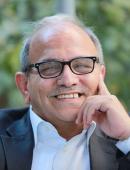
"Media and political sources report that the Netanyahu government is exploring ways to strengthen the PA and prevent its collapse," notes Palestinian commentator Hani al-Masri on the independent Palestinian news-portal www.masarat.ps.
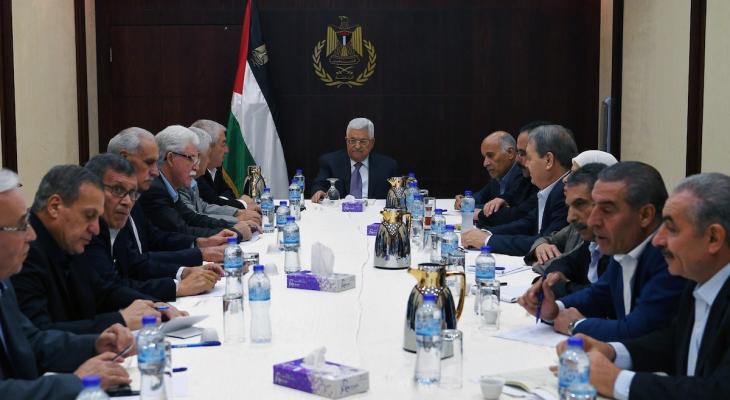
They also report that President Mahmoud 'Abbas is considering the idea of appointing a VP in response to external pressure to close the loophole created by the dissolution of [the PA's legislative body] the Palestinian Legislative Council (PLC), whose absence would give rise to a constitutional vacuum in the event that the presidential office becomes vacant, especially in light of the president's advanced age.
According to the PA Basic Law, the PLC chairperson would serve as interim president for a period of sixty days until presidential elections are held. This is what happened after the late president Yasser Arafat's assassination; Rawhi Fattouh served as Arafat's replacement until Mahmoud 'Abbas was elected president.
According to informed sources, the formation of the new Constitutional Court is part of the preparations for the transitional phase. There are several legal opinions that involve the appointment of a VP through the selection of a specific person or by deferring to the incumbent holder of the VP office. This would require issuing a law creating said VP office or authorizing the unelected Palestinian Central Council (PCC) – which replaced the elected PLC and was unlawfully granted the powers of the Palestinian National Council (PNC) [the PLO's legislative body] – to resolve the matter by empowering the PNC chairman or the head of the Constitutional Court to serve as interim president during the transitional phase until elections are held. However, internal and external parties, especially the occupation, will not permit elections to be held unless the results are guaranteed.
For all its importance, the law is not itself the decisive factor. Rather, it is power dynamics, internal designs, and foreign interventions that decide an issue of the magnitude of the presidential succession, for the simple reason that the legitimacy of all Palestinian institutions has eroded.
On the one hand, the formation of a new PNC is long overdue. Everything that has transpired recently has occurred unlawfully, from the appointment of new members and the expulsion of old members, including PLO founders, to the PCC undertaking the election of PLO Executive Committee members instead of the PNC, as stipulated by the PLO Basic Law. The same goes for the election of the Palestinian National Fund (PNF) chairperson, whom the law clearly stipulates must be directly elected by the PNC. Moreover, the quorum of political forces has not been met due to founding factions of the PLO boycotting proceedings as well as the failure to invite certain dignitaries and influential factions like Hamas, Islamic Jihad, not to mention the lack of respect for the PLO's status as the official representative of Palestinians everywhere. There is also the absence of an agreed-upon national program since the adopted program under the Oslo Accords hit a dead end, as well as the lack of a national consensus capable of imparting temporary legitimacy until presidential, legislative, and PNC elections are held and institutions are rebuilt based on the principles of true national, democratic partnership.
On the other hand, presidential and legislative elections have not been held since 2005 and 2006, respectively, which undermines the legitimacy of the current establishment. So the solution does not lie in appointing a VP, which would only complicate matters further and open the door to more external intervention and more conflict over who will become VP. Would the office belong exclusively to Fatah, or would it be a Palestinian affair? Would the candidates be limited to the controlling faction, or include all national factions and other individuals, such as Marwan Barghouti, who is the most popular presidential contender by far according to polls on the issue?
Of course, the president does not welcome the idea of a VP, at least at this time, for two reasons: First, because it opens the doors to intense competition over the succession during the president's term, in the absence of any candidate capable of settling the issue. Second, and more importantly, the president realizes that the countdown to the end of his tenure begins the moment that a VP is appointed. This would embolden local, regional, and international players to push for a transfer of power – including Israel, which has played and continued to play a significant role in such matters. This is especially true in the presence of a weakness of leadership, if not a leadership vacuum. There is a lack of effective leadership; the president's conduct in recent years has been marked by a strategy of clinging to power and waiting, which has weakened the PA.
What the PA, the PLO, and the Palestinians as a whole need is radical change spearheaded by the parties, forces, and individuals that have sustained harm from the adopted approach, after the path (or paths) followed have led us to the disaster we are experiencing today. Israel has transitioned from a program of creeping annexation, gradual encroachment, and creating facts on the ground as a prelude to imposing an Israeli solution, to a program to swiftly settle the conflict through rapid annexation, displacement, and Judaization.
We reject the appointment of a VP, as it would mean perpetuating the disastrous status quo and keeping Palestinian decision-making in the hands or at the mercy of the occupation, which now controls everything. Netanyahu's recent statements about crushing the idea of Palestinian statehood and blocking Palestinian aspirations for an independent state do not reflect a radical change in Israel's original stance, but rather mark the start of a new phase in which the Israeli government seeks to impose its position regarding annexation on everyone, from the Palestinians to the Americans and others, and push them to abandon the discourse and demand for a two-state solution while accepting or coexisting with the Israeli solution currently being implemented, which permits nothing more than limited self-rule (through two, three, or more authorities) under Israeli sovereignty.
Netanyahu's talk of strengthening the PA and preventing its collapse and bankruptcy is ridiculous and meaningless. Everything the occupation is doing – including aggression campaigns, assassinations, home demolitions, displacement, settlement expansion, suffocating blockades, severing lifelines, racial discrimination, and incursions into areas including Palestinian cities in a manner that has completely erased any distinction between Areas A, B, and C – only exposes the PA and marginalizes its role further and further. This includes killing the peace process and the two-state solution and withholding tax funds under the pretext that the PA disburses salaries to prisoners and the families of martyrs. After all this, Netanyahu claims to want to financially assist the PA and prevent its collapse and bankruptcy!
The PA which was established in the wake of the Oslo Accords, and which was involved in a political process, negotiations, and mutual commitments, however flawed, and was meant to be a transitional phase on the path to statehood, has long since died. The PA that Netanyahu wants to sustain and rebrand is the new, functional institution that is integral to Israeli security. Israel does not negotiate with it, but imposes terms and diktats on it. It does not represent the identity and national rights of the Palestinian people, but scattered individuals and groups who are rewarded with crumbs and benefits in exchange for betraying their people's interests and aspirations. Therefore, what is needed is not the appointment of a VP to lead this new PA, but rather a PA of an entirely new caliber that is part of the Palestinian people's struggle against the occupation and for national liberation.
When Netanyahu disagrees with ministers in his government because they want to dissolve the PA, on the grounds that it represents a national identity, and replace it with disparate local administrations, he does not want the Oslo PA, for all its flaws, but a distinctively traitorous PA, and he does not want the struggle over the succession to lead to the collapse of a PA that serves Israel's interests.
The way out of this deep Palestinian crisis is not through a new agreement for inter-factional unity like so many that came before. The Palestinians need something far greater than that; they need to revive and redefine their national project in light of the new circumstances, dangers, and realities, while taking into account new experiences, available opportunities, and regional and international development. Anyone who takes on this task holds the key to salvation and is fit to lead the Palestinian people. Therefore, the following is imperative:
First: For the Palestinians to renew their commitment to their national project after redefining it, and for them to know exactly who they are, where they stand, what they want today and in the medium and long term, and how to achieve it.
Second: For the forces, institutions, and individuals who believe in reviving the national project, the resistance option, and the unity of the people, the cause, the land, and the historical narrative to take the initiative and act to impose the Palestinians' will and interests and block hostile plans.
"This includes blocking the installation of a successor, leadership, and PA that are completely subservient to the occupation, thereby perpetuating the status quo and turning it into a final solution," concludes Masri.