
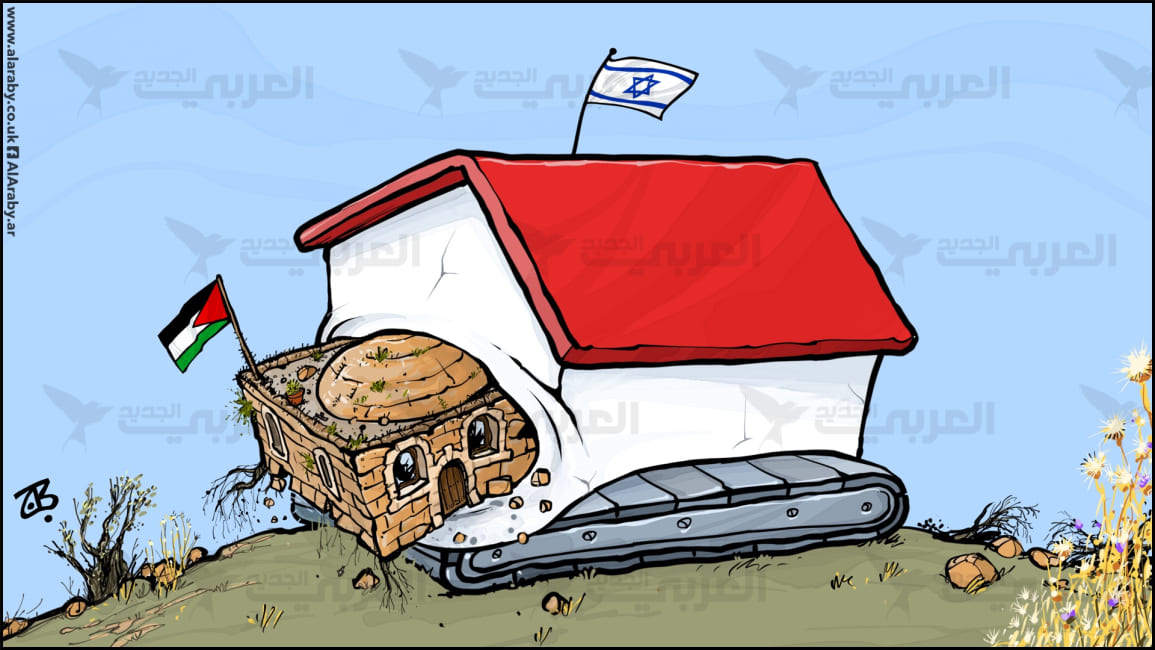

In a recent analysis, Hani Al-Masri argues that the Palestinian people are living through “the most dangerous phase in their modern history,” and yet continue to show “an exceptional capacity for steadfastness and for holding fast to their land and their rights.”
Across Gaza, the West Bank, Jerusalem, the Palestinians of 1948 inside Israel, and the diaspora, he writes, Palestinians are the target of “an open-ended war that encompasses genocide, forced displacement, and ethnic cleansing,” unfolding alongside accelerating settlement expansion and annexation. Behind all of it, he contends, lies “an Israeli project that seeks to settle the conflict by imposing facts on the ground through force” and putting an end to the Palestinian cause.
Even so, Al-Masri cautions against reading the moment as a prelude to mass revolt. The objective conditions, he writes, “do not appear ripe for a comprehensive uprising or a broad escalation” ,and he casts Israeli claims to the contrary as a pretext “to justify the continued mobilization of occupation forces, the ratcheting up of repression, and the commission of still more crimes against Palestinians.”
The national priority, in his account, is endurance rather than escalation: to furnish Palestinians with “every means of steadfastness and survival,” to strengthen their capacity to “stand firm on their land,” and to form “popular protection committees for self-defense and the safeguarding of civilians” ,committees open to “every force and actor, without exception” and bound together by “a unifying national vision, a comprehensive strategy of struggle, and a single, unified national leadership.”
Al-Masri anchors his analysis in a recent flashpoint: the storming of the village of Tell by a group of settlers, which left “four Palestinians martyred and two Israeli soldiers dead” after, he recounts, one of the village’s sons “managed to wrest away the weapon of one of the assailants and open fire.” That episode, he insists, cannot be read “as an isolated event, detached from the broader context of what is unfolding across the West Bank.”
What is happening today, he argues, is the continuation of a program set in motion four years ago, when the current Israeli government was formed on a platform that “explicitly called for annexing the West Bank” while leaving the timing to the prime minister’s calculations about Israel’s international standing. In practice, he writes, the government also embraced what is known as the “Decisive Plan” ,a drive to “confiscate the largest possible area of Palestinian land, Judaize and settle it, and drive out the largest possible number of Palestinian inhabitants.”
Netanyahu’s government, “which includes Smotrich and Ben-Gvir,” found in the events of October 7, 2023, what Al-Masri calls “the perfect opportunity to put its program into effect” ,waging “a war of genocide, displacement, and occupation” in Gaza while, in the West Bank, escalating “de facto annexation, the gradual nibbling away of land, the systematic expulsion of residents, and the imposition of facts on the ground.”
For Al-Masri, the figures make the case. He reports that over the past year the Israeli government “approved the construction of ten thousand settlement units, multiplied the settlement budget several times over, [and] put tens of thousands of weapons in the hands of settlers,” giving them “free rein to assault Palestinians and shoot at them.”
He cites 11,074 assaults in the first half of the year ,3,488 of them by settlers and the rest by soldiers ,and describes the storming of al-Aqsa Mosque as “a daily habit,” peaking on Jewish religious occasions “amid mounting calls to demolish it and raise ‘the Temple’ in its place.”
The human toll he sets out is stark: “more than 1,200 Palestinians… martyred in the West Bank” since October 7, with 87 killed since the start of this year, 21 of them by settlers; “more than 20,000 Palestinians… detained” and subjected to “every manner of torture.” On the ground, he writes, the occupation has “wiped out 118 residential communities,” razed three refugee camps in Jenin and Tulkarm, displaced “tens of thousands,” and destroyed “45,000 trees, among them 26,000 olive trees,” while “15,000 head of livestock” were seized and “hundreds of homes, vehicles, and farms” set ablaze.
Al-Masri also charts the steady hollowing-out of the Palestinian Authority: 21 new outposts in Area B, “which is supposed to fall under Palestinian civil control”; powers transferred to “the Civil Administration under the Israeli war ministry”; “upward of five billion dollars in clearance revenues” withheld; and the West Bank “sown… with more than 1,200 checkpoints and gates” that turn communities into “isolated islands and open-air prisons.” Only about 10 percent of the population, he notes, now lives in Area C ,“even though it makes up more than 60 percent of the territory’s land.”
He points to the finance minister, Bezalel Smotrich, and “his intention to establish one hundred settlement outposts in Area A,” and echoes the warning of The Elders that “Palestine is in danger of vanishing from the map altogether.”
The measures Israel rushed to adopt after the events at Tell ,collective punishment, reinforcements, a tightened siege, more checkpoints, movement bans, mass arrests, and the legalization of outposts ,are, for Al-Masri, proof that this is “the execution of a plan drawn up well in advance,” and “not some knee-jerk reaction to security incidents.” He notes that protection was extended even to settlers who had “torched homes, farms, vehicles, and even mosques,” amid calls “to raze the village of Tell as was done in the Gaza Strip.”
He is equally pointed about the Israeli narrative that the West Bank is “gearing up to stage its own October 7.” That claim, he writes, is cover “for the schemes [Israel] had prepared in advance” ,and he warns Palestinians against echoing it. “The West Bank is exposed and sitting in the eye of the storm,” he writes; it “possesses none of the ingredients to wage effective resistance or to mount a new intifada.” What it can do, “within its means and its present circumstances, is to stand its ground and organize forms of self-defense.”
Al-Masri attributes the muted Palestinian response to “the war of attrition the West Bank has endured since 2015” ,the “Knife Intifada” and the waves that followed in Jerusalem, Jenin, and Nablus ,and to a Palestinian leadership that has embraced a “realist” policy “that bends to reality rather than engaging with it in order to change it.” That posture, built on “keeping its head down, avoiding confrontation… and preserving the leadership, the president, and the Authority at any cost,” has, in his view, “only emboldened the occupation and the settlers.”
The ultimate Israeli aim, he argues, is to empty the land and hold on until conditions are ripe to proclaim “a ‘Greater Israel’ from the river to the sea” ,“one way station,” as he puts it, “on the road to the broader Zionist project ‘from the Nile to the Euphrates.’”
He is scathing about “the fascist character that has marked Israeli government policy since October 7,” and about the “ruinous Palestinian split” that persists “despite a war of genocide,” deepening “frustration and despair” at a moment when unity “has become a vital necessity, not merely one political option among many.”
For all Israel’s “military, economic, and technological superiority,” Al-Masri insists its “ambitions and objectives outstrip its capacity to achieve them.” It has shown itself “beholden to its American master,” he writes, “unable to remake the Middle East or to bring a Greater Israel into being.” The Zionist narrative, in his telling, “has collapsed with a resounding crash,” and the government “has not scored a decisive victory in any war on any front.” With its popularity in decline and its electoral prospects shrinking, he warns that “the next few months are likely to bring a major escalation, in a last-ditch bid to improve its chances at the ballot box.”
It is not enough, he argues, for the leadership to “confine itself to appealing to the world to intervene” or to documenting Israeli crimes, important as that is. He calls for “a comprehensive vision and a unified leadership built on an integrated strategy” ,one that mobilizes “every means of steadfastness and survival,” particularly in areas “threatened with genocide, annexation, displacement, settlement, and apartheid” ,and insists that Palestinians not be stripped of “their legitimate right to defend themselves, their families, their communities, and their property, as international law guarantees.”
That strategy, in his account, would rest on “ending the occupation” and giving form to “the independence of the State of Palestine”; on holding Israel to account “through boycott and sanctions… halting the flow of arms to it… [and] the withdrawal of recognition,” alongside efforts “to suspend its membership in the United Nations”; and on pursuing Israel and “all of its officials,” on the understanding that their acts amount to “systematic official policy, not merely isolated personal acts.”
Above all, he returns to where he began, forming “Palestinian popular protection committees in the threatened cities, villages, and communities.” It is, he writes, the surest way “to strengthen the capacity of Palestinians to stand firm and to defend their very existence in the face of the most dangerous settlement project to threaten their cause in decades.”