
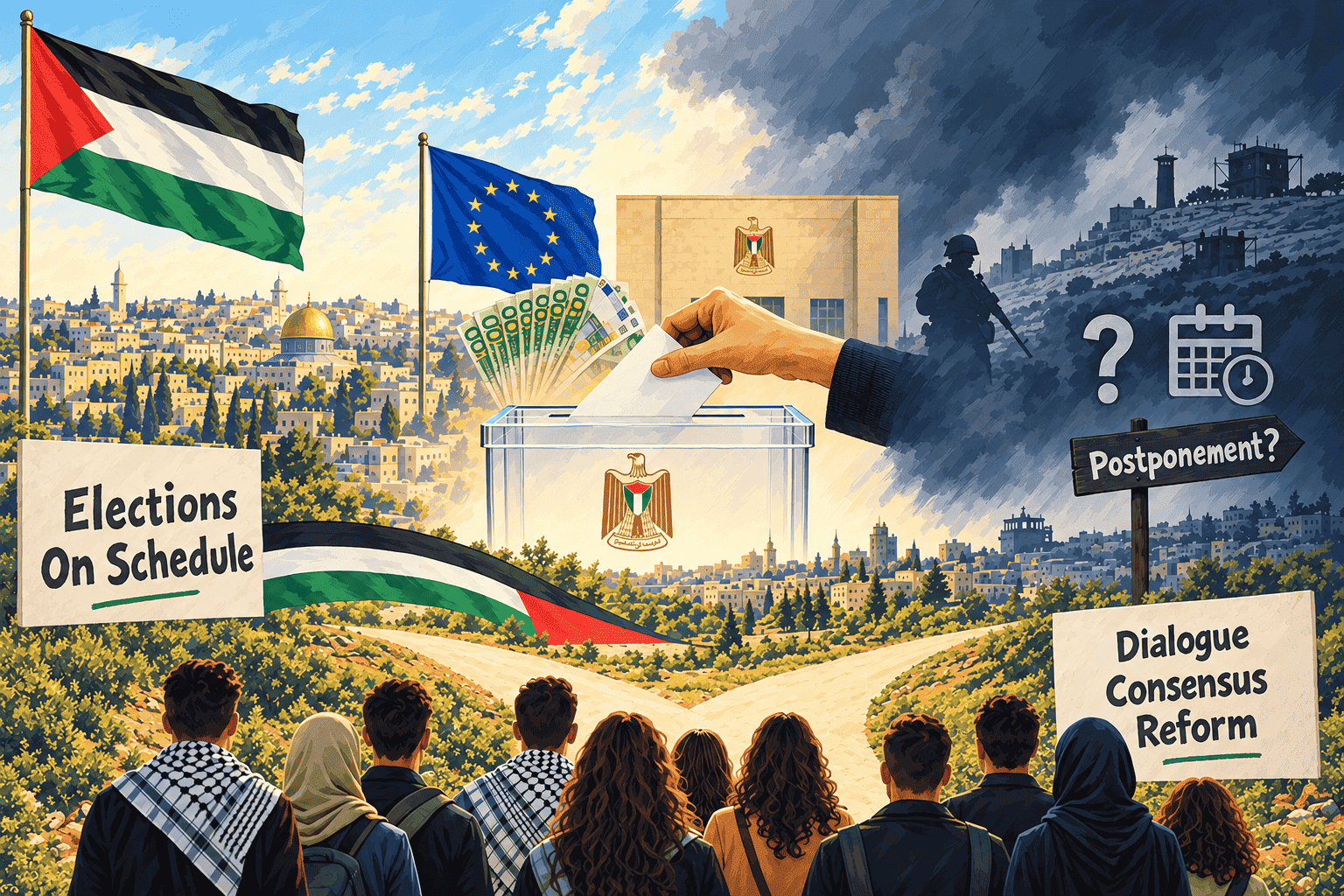

Registration for electoral lists is due to open this coming Saturday, and the Central Elections Commission has announced that it is ready to conduct the elections. This has encouraged the European Union to release a tranche of the funds it had pledged to cover the cost of the elections. The President and several Fatah leaders have likewise reaffirmed their commitment to holding the elections on schedule, provided that the occupying state does not obstruct them.
And yet, despite all these preparations and assurances, the specter of postponement continues to hang over the process.
The Fatah Central Committee is meeting today, Thursday, while the Executive Committee of the Palestine Liberation Organization is due to meet on Saturday. Two positions are now taking shape.
The first calls for proceeding with the elections as scheduled. If they are not held, proponents of this view argue, the occupation should bear responsibility for their failure. A Palestinian decision to postpone the elections, they warn, would inflict serious damage on what remains of the leadership’s legitimacy and credibility, as well as on what remains of the Palestinian institutional framework, particularly in the eyes of Arab and international actors that support holding elections, most notably Europe.
France’s foreign minister has even threatened to suspend support for the Palestinian Authority if the elections are postponed by the Palestinian side. From this perspective, moving ahead with the elections is therefore considered necessary to restore and renew Palestinian legitimacy, strengthen Palestinian representation, and preserve the unity of the West Bank and Gaza. It could also pave the way for the formation of a government that would be recognized by most of the international community, although the United States and Israel would oppose it.
According to this argument, such a government could obstruct, and perhaps derail, the U.S. plan for the Gaza Strip, which is expected to come under the supervision of a Peace Council tasked with implementing the Trump plan and UN Security Council Resolution 2803.
Washington, Mr. Hani notes, has also made its position clear. Jared Kushner has reportedly conveyed to relevant parties that the United States opposes Hamas participating in the elections, even indirectly, before the movement relinquishes power and disarms, in line with the commitments Hamas accepted under the agreement reached at the end of July.
The Netanyahu government, meanwhile, would oppose the elections whether Hamas participated directly or indirectly, he argues. In this reading, elections would frustrate Israel’s efforts to occupy, settle, and displace Palestinians from the Gaza Strip through the continuation of the war, siege, and economic strangulation.
They would also lead to the creation of a legitimately elected council embodying Palestinian national identity and keeping the door open to the establishment of a Palestinian state, at a time when, Mr. Hani argues, the Israeli government has managed since taking office to “bury the possibility” of such a state.
The case for postponement
The second position calls for postponing the elections in order to hold a national dialogue and establish the conditions necessary for genuinely free and credible elections.
Supporters of postponement fear a repeat of what happened in 2006, perhaps in an even more serious form, given that the elections would be held under occupation and amid continuing Palestinian division. In their view, this would amount to walking into “a minefield that could explode at any moment.”
The concern is that these would become elections aimed at defeating the other side rather than elections based on political partnership. Instead of healing the Palestinian divide, they could deepen fragmentation and potentially produce two competing centers of power, one in the West Bank and another in Gaza.
That risk would become particularly acute if the results failed to produce the political configuration envisioned by the decree, or if widespread allegations of manipulation and fraud were to undermine the elections’ legitimacy.
Those advocating postponement therefore call for agreement on the procedures, legislation, and timing of the elections, while placing the entire process within a broader national strategy for confronting U.S. and Israeli plans for the West Bank and Gaza, as well as for the various dimensions of the Palestinian cause, particularly the right of return.
Yet the advocates of postponement face their own problem: the delay being discussed is reportedly not simply until next March. Rather, it would have to extend until the end of next year, and possibly even longer, until the Peace Council completes the period assigned to it under the relevant Security Council resolution.
Sources close to the Peace Council have reportedly indicated that the Council will ask the Palestinian Authority not to hold elections before the end of the transitional period.
The internal calculations
There are also Palestinian actors and interests pushing for postponement out of concern that the official Fatah list could lose amid a crowded field of competing Fatah lists.
Mr. Hani argues that the leadership had initially assumed it could engineer the electoral process and control its outcome. That calculation has become increasingly difficult as other lists take shape: a list led by Qadura Fares, reportedly expected to receive the backing of imprisoned Fatah leader Marwan Barghouti, whose popularity remains considerable and who is seen as having a strong chance in a presidential election if one is held; a list backed by Fatah’s Reformist Current; Hamas, without the direct participation of its leaders and cadres; Islamic Jihad; the Democratic National Forum; and others.
There is also the “Change” list, bringing together the Popular Front for the Liberation of Palestine, the Palestinian National Initiative, and independent national figures, alongside dozens of other lists representing families, clans, businesspeople, and various centers of influence.
The decision to lower the electoral threshold to 1 percent has encouraged many more groups to enter the race. But Mr. Hani warns that this could transform what is supposed to be a national election into something resembling a series of local contests, particularly given what he describes as the ossification, aging, and weakening of the Palestinian factions, and the threat of arrest and assassination facing lists representing resistance forces.
The result, he argues, could be a significant number of wasted votes and a legislative council fragmented into a multitude of electoral blocs, many of them lacking substantive political programs and dominated by narrow regional or private interests.
As he puts it, invoking a line attributed to Voltaire: “When the great dreams and projects fall, everyone tends to his own garden.”
What if things had been different?
Mr. Hani then turns to what might have been possible under different political circumstances.
“If only…”, as the Arabic saying goes, “if” opens the door to the devil, Palestinian leaders and political forces had risen to the scale of the challenges facing them, or if new movements and forces had emerged capable of meeting the demands of this historic moment, then proceeding with the elections could have been placed within a much broader effort to reunify Palestinian forces and bring together representatives of the various Palestinian communities.
Such an approach, he argues, would be built on genuine partnership, preservation of political pluralism on national foundations, and consensual democracy.
It would also place greater emphasis on people’s immediate concerns and everyday livelihoods, particularly amid the ongoing war of genocide and displacement, annexation, apartheid, settler attacks, and what he describes as a plan to “liquidate the Palestinian cause from its roots.”
Under such circumstances, the electoral process could have become part of a broader effort to reformulate the Palestinian national project, with the National Charter at its heart; establish unified leadership committed to preserving the unity of the Palestinian cause, land, people, and historical narrative; and safeguard the PLO’s status as the sole representative of the Palestinian people.
That, in turn, would require rebuilding the PLO’s institutions so that it would be, “in word and deed,” the sole legitimate representative of the Palestinian people, while closing the door to trusteeship arrangements and alternative bodies, as well as to the various plans aimed at liquidating the Palestinian cause.
Finally, Mr. Hani argues, there must be agreement on a general political program, along with political programs tailored to each Palestinian constituency, and on the strategies needed to translate those programs into practice.
Note: This is not a literal, word by word translation of the original article. It is an English adaptation that conveys all of the original article’s ideas and follows its argument and sequence. Direct quotations are taken from the original article.