
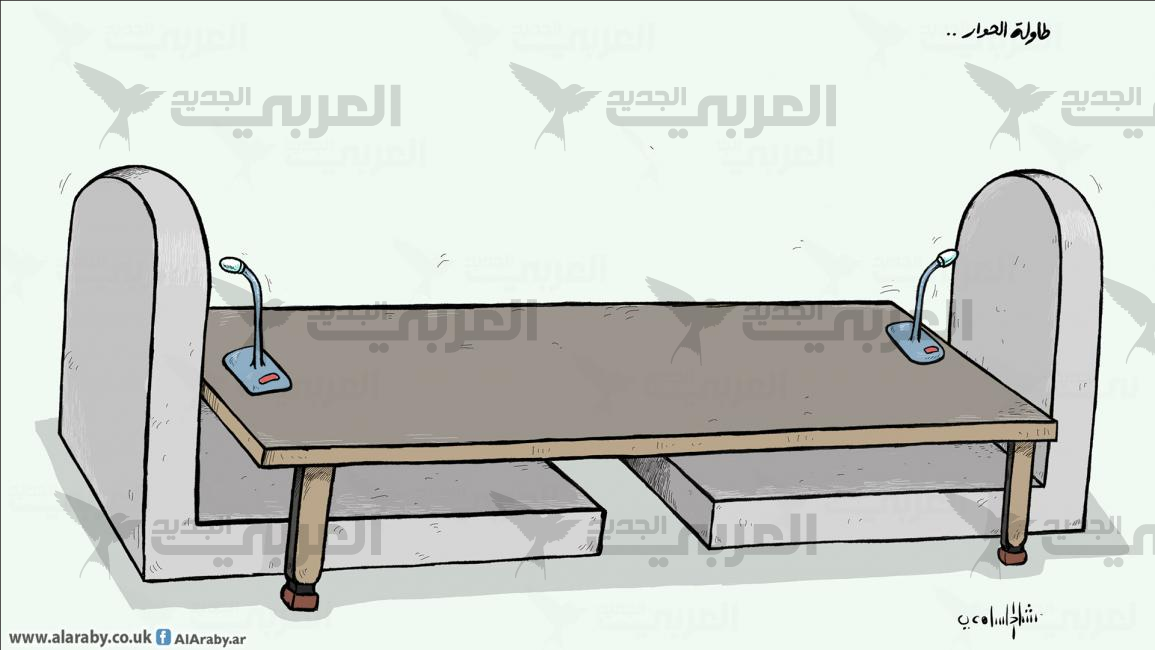

Even as Palestinian electoral lists have begun to be submitted, the spectre of postponement continues to hang over the elections. At the same time, preparations are underway for a national dialogue that appears, at least in part, to be intended to provide political cover for such a postponement. Yet the dialogue itself faces obstacles that could prevent it from taking place unless the internal Fatah situation is put in order and the “new” Hamas is accommodated within the Palestinian political system.
Hani Al-Masri argues that, if the dialogue is to succeed, the way it is convened, who takes part, and what it is meant to achieve must all change. Otherwise, he warns, the process risks producing the same results as before. As the saying goes, he writes, “the one who tries what has already been tried has only himself to blame.”
Time, however, is running short. The window for reaching a national agreement before the elections is narrow. Yet Al-Masri maintains that with sufficient political awareness and the necessary will, even what appears impossible can be achieved. The stakes, he argues, are existential: the challenges facing the Palestinian political system in all its components could push it toward collapse. Betting on the outcomes of the US or Israeli elections, or on other unpredictable developments, will not be enough. The first bet, he says, must be “on the people and their living forces,” followed by those who support the Palestinian cause and the principles of freedom and justice across the region and the world.
A new government may indeed emerge in Israel after the elections, Al-Masri notes, but that scenario is far from certain. Even if it does happen, he argues, it is unlikely to be a government of peace. At most, it could be less extreme than the current government, which he says is committed to the idea of a Greater Israel and to reshaping the Middle East, while seeking to determine the outcome of the conflict with the Palestinians rather than reach a negotiated solution. For Al-Masri, however, even such a change would not be enough, and certainly cannot substitute for what Palestinians themselves can and must do.
What Palestinians need, he argues, is a national dialogue whose central task is to formulate a rescue plan for the Palestinian cause, land, people and rights. Achieving this requires both a change in the dialogue’s objectives and a broader definition of who gets a seat at the table. It should not be confined to political factions, but should also include representatives, in proportion to their weight and role, of women, youth, the diaspora, civil society, the private sector, and independent public figures.
Elections Caught Between Internal and External Pressures
Al-Masri identifies both external and internal challenges to the elections.
According to accounts from several sources cited by him, the United States opposes elections that include the Gaza Strip unless Hamas first relinquishes power, disarms, and transforms into a political party, with the possibility of participating indirectly thereafter. Israel, meanwhile, rejects Palestinian elections in principle or seeks to control the conditions under which they are held, citing Hamas’s participation as one of its stated objections. Al-Masri argues that Israel’s deeper position is tied to a broader effort to continue what he describes as the liquidation of the Palestinian cause and the creation of new realities on the ground.
Inside the Palestinian arena, he points to another source of concern: fear of what the elections might produce, particularly among the ruling political elite, which he says fears losing political leverage and power amid widespread public anger.
He also discusses the possibility of a broad electoral alliance involving, in one form or another, the “Reformist Current” within Fatah, Hamas, the Democratic National Forum, and other forces, with support from Islamic Jihad and potentially the participation of imprisoned Fatah leader Marwan Barghouti. If such an alliance were to emerge, Al-Masri argues, it could significantly alter the political balance and the rules of the game.
But, in his view, the central question is not simply whether elections should be held. It is the circumstances in which they would take place, the rules governing them, who would benefit from their outcome, and whether they could genuinely produce national legitimacy.
Elections in any democratic system, he explains, are not merely a technical exercise of casting and counting ballots. They are a means of renewing legitimacy, embodying political pluralism, and bringing people and institutions together on the basis of popular will. Holding elections under occupation and division, without a unifying national project, a shared political programme, or foundations for partnership, could therefore produce the opposite of what is intended.
Instead of renewing legitimacy, elections could become a mechanism for entrenching the existing division and status quo, effectively reinforcing the Palestinian Authority’s role as an administrator of a population under occupation rather than an instrument for changing that reality.
The Occupation as the Central Obstacle
Al-Masri identifies what he considers “the first and greatest obstacle” to any free and fair Palestinian election: the Israeli occupation itself.
He argues that Israel has no interest in elections that would strengthen Palestinian leadership, give it renewed popular legitimacy, reunify the West Bank and Gaza under elected leadership and institutions, and reaffirm a unified Palestinian identity in a way that could open a path toward Palestinian statehood.
He points to Israel’s military control over the West Bank and large parts of Gaza, its control over crossings and points of entry, and its use of blockade, raids, closures, arrests and assassinations, alongside the war and displacement in Gaza and settlement expansion, gradual annexation and land confiscation in the West Bank. He also argues that political, financial and security pressure is being used to weaken the Palestinian Authority and undermine its ability to carry out its functions.
Settler attacks, raids, closures, checkpoints and gates, he adds, impose direct restrictions on daily life and on the practical possibility of conducting normal elections. He notes that the number of checkpoints and gates across the West Bank is around 1,300, many of which can be closed at any time, restricting the movement of voters, candidates and election workers.
In Gaza, the scale of destruction, displacement, deaths, missing persons and detainees resulting from the war has created conditions in which free elections would be extraordinarily difficult. Movement restrictions also affect candidates, voters, electoral materials and international observers who are prevented from entering the Strip.
A second major obstacle, Al-Masri argues, concerns the participation of Hamas and other political forces designated as terrorist organisations by the United States, Israel and some other countries.
If the purpose of elections is to renew legitimacy, unify the political system and express the will of the Palestinian people, he asks, how can they be free if a major political force, or several forces, is prevented from participating, directly or indirectly?
He stresses that this position does not amount to agreement with Hamas’s programme, policies or opposition to it. Rather, he frames it as a basic democratic principle: citizens’ right to choose who represents them, political forces’ right to compete, and acceptance of the results regardless of the outcome.
Conditions imposed by foreign governments and donors, he argues, should not become a mechanism for excluding a Palestinian political actor before the electoral process even begins. If there are concerns about Hamas’s programme, weapons or political positions, he says, they should be addressed through clear political and legal rules that apply to everyone, rules determined by Palestinians and responsive to their priorities, interests and needs.
He also highlights what he sees as a contradiction in the international approach: Palestinian candidates may face externally imposed conditions concerning recognition of the Palestine Liberation Organization, its programme and international legitimacy, while comparable conditions are not imposed on Israel despite the grave violations attributed to its government.
At this point, Al-Masri issues a warning against what he calls “the myth” that the United States, Israel and other regional and international actors are pressuring the Palestinian Authority to hold elections. In his view, this is an illusion. He argues that Europe is the only actor genuinely seeking elections, largely in response to public opinion in European countries, and that if Europe wants free elections, it should put pressure on those obstructing them—above all, the occupation, rather than focusing only on the Palestinian Authority.
Elections Alone Will Not End the Division
Al-Masri stresses that elections by themselves cannot resolve the Palestinian political divide. Without prior national understandings on the rules of the political game and the purpose of the elections, they could simply become another arena for political rivalry and domination.
The absence of the Palestinian Authority from Gaza also raises the question of who would oversee the elections there and whether that body would be able to establish a reliable electoral register or handle civil records fairly, particularly amid war, destruction, deaths, disappearances, displacement and major demographic changes.
Another concern is holding legislative elections separately from presidential elections in a political system that is effectively presidential in character. This, he warns, could produce dual legitimacy, an elected legislative council alongside an unelected president, rather than renewing legitimacy and unifying institutions.
The regional and international dimension cannot be ignored either, Al-Masri argues. Referring to what was reportedly said by US President Donald Trump’s envoy Jared Kushner in discussions with Hamas, he says the US administration opposes elections that include Gaza unless Hamas relinquishes power and disarms, while allowing for indirect political participation afterwards.
Al-Masri notes that Hamas had agreed to implement an arrangement that included relinquishing power and disarming, but argues that Netanyahu’s government prevented its implementation, thereby keeping its hands free to continue what he describes as the war of extermination and displacement.
He further argues that Washington may also object to a legislative council representing both the West Bank and Gaza because such an elected body would produce a Palestinian reference point with popular legitimacy, potentially complicating proposed arrangements for Gaza.
This, he says, raises a fundamental question: Are Palestinian elections meant to renew legitimacy and reunify the people and institutions, or are they being designed in advance to fit political arrangements imposed from outside?
If the conditions of an election determine in advance who may participate, who may win, and how the results will be treated, Al-Masri argues, then the election loses an essential part of its democratic meaning and undermines internationally recognised standards for free and fair elections.
At the same time, he stresses that responsibility for creating democratic conditions does not rest solely with the occupation and international actors. The Palestinian Authority must also review political restrictions on candidacy and guarantee equal opportunities for all lists and candidates.
Elections cannot be credible, he argues, if state resources and institutions are used, directly or indirectly, to benefit a particular political list—including Fatah’s official list. The authority in power should act as a referee between competing sides, not as one of the players.
Neither Postponement nor Elections at Any Cost
Al-Masri is careful to distinguish between rejecting elections altogether and insisting on holding them regardless of the circumstances.
“The solution is not to reject the elections,” he writes, “just as holding token elections, tailoring them to fit, or postponing them to a specified date—or indefinitely—is not a solution either.”
What is needed, he argues, is an effort to ensure that elections fulfil their fundamental purpose: renewing legitimacy, ending the political division, and producing leadership with genuine popular confidence—leadership capable of representing Palestinians, confronting the occupation, and creating the conditions necessary for resilience and survival.
He identifies two essential requirements.
First: National Consensus on the Rules and Purpose of the Elections
There must be a minimum level of national agreement on electoral laws and rules, as well as on the purpose of the elections.
Their purpose, Al-Masri argues, should be to serve the national struggle to end the occupation—not to entrench the Authority’s role as an administrator of a population under occupation. All sides should also commit in advance to respecting the results and not excluding any party that accepts the rules of the democratic process.
There should likewise be prior agreement on how to deal with Israeli interference, including the arrest of candidates, voters or elected representatives; restrictions on movement; preventing elections in Jerusalem, Gaza or Area C; and the confiscation or nullification of results, as happened following the 2006 elections.
An election cannot truly be democratic, he argues, if one side can use military force to determine its outcome.
Second: Genuine International Guarantees
Simply sending observers to watch the voting process is not enough. What is required, Al-Masri argues, are political and legal guarantees ensuring that elections take place in a free and fair environment, preventing the occupation from obstructing the process or interfering with its results.
Such guarantees should protect the freedom of movement of voters and candidates, prevent their arrest or assassination, and prevent ballot boxes or electoral results from being confiscated. They should also establish a clear mechanism for dealing with any Israeli attempt to prevent the elections or overturn their results, including transitional arrangements agreed upon in advance.
So, What Kind of Elections?
The question, Al-Masri concludes, is therefore not simply whether Palestinians want elections, but “What kind of elections do we want? For what purpose? Under what conditions? And who will guarantee that their results are respected?”
If elections are capable of renewing legitimacy, reunifying the West Bank and Gaza, and rebuilding the political system around pluralism and partnership, he argues, then they are a national necessity.
But if they are held while a major political force is excluded, the division remains unresolved, guarantees are absent, the occupation continues to dominate the environment, state resources are used in favour of one side, and there is no assurance that the results will be respected, then elections could become the very opposite of what they are supposed to achieve: rather than renewing legitimacy, they could serve to entrench division, the realities of occupation, and the existing structure of the Palestinian Authority while giving them a veneer of legitimacy.
For this reason, Al-Masri argues, the answer is neither indefinite postponement nor holding elections at any cost. What is required is to create the minimum political, legal and international conditions that would make elections both possible and meaningful.
As he puts it, “free elections do not begin at the ballot box.” They begin with the right of all to participate, equal opportunities, freedom of competition and movement, protection from interference by the occupation, the Palestinian Authority or any other actor, and a prior commitment to respect the will of voters and the results of the ballot.
Without these foundations, Al-Masri concludes, elections will remain unable to deliver what Palestinians need today more than ever: renewed legitimacy, restored national unity, leadership capable of confronting the occupation, the means to sustain Palestinian resilience and survival, and the defence of Palestinian national rights.
Note: This is not a literal, word by word translation of the original article. It is an English adaptation that conveys all of the original article’s ideas and follows its argument and sequence. Direct quotations are taken from the original article.