
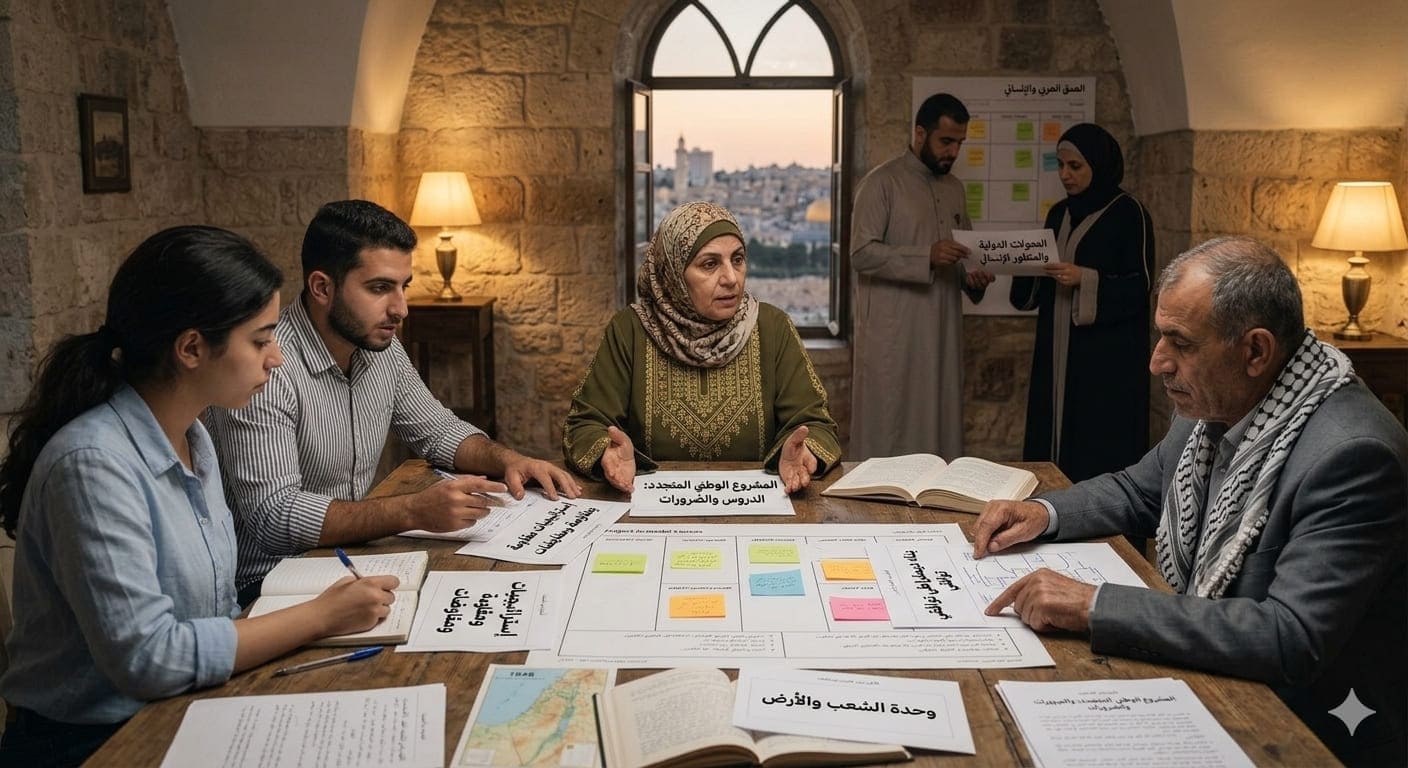

On the anniversary of the October 7 “Al-Aqsa Flood,” Palestinian political analyst Hani Al-Masri argues that the Palestinian cause needs more than another assessment of the latest developments. It needs a deep and courageous reckoning with its entire experience, from the launch of the Palestinian revolution to the present day. The central questions, he says, are difficult but unavoidable: Where did the Palestinians get it right, and where did they go wrong? Why has the Palestinian people not achieved victory despite decades of resistance, sacrifice, immense suffering, and extraordinary courage? And what would it take to launch a new phase capable of achieving victory?
Al-Masri cautions against reducing the Palestinian experience to a simple choice between two disasters: the “Al-Aqsa Flood” and the ensuing human catastrophe and genocide on the one hand, and the Oslo process and negotiations, which he says produced a political catastrophe, on the other. The reality, he argues, is that all strategies have reached an impasse. The clearest evidence is that the condition of the Palestinian cause on the ground is worse today than it was before Oslo.
While negotiations bear a significant share of responsibility, Al-Masri argues that it would be equally misguided to place the blame solely on them, or solely on resistance. Resistance, he stresses, is a means, not an end, and treating either resistance or negotiations as an end in themselves has been one of the major mistakes.
He acknowledges that the resistance has made serious mistakes and has not achieved victory. Yet, he argues, without resistance, the Palestinian cause would not have remained alive, half of the Palestinian people would not have remained on their homeland, and Palestinians inside and outside the country would not have continued to carry their national cause. Without it, he says, the Palestinian issue would have remained a humanitarian matter concerning individuals, rather than the cause of a people with rights, foremost among them the right to self-determination.
This, Al-Masri argues, is precisely what is being sought today: to reduce the Palestinian cause once again to a humanitarian issue concerning individuals and an authority administering their affairs under occupation, while allowing the still-unfinished Zionist colonial project to pursue its broader objectives.
That project, he notes, has not yet achieved all of its goals. It has neither brought all, or even most, Jews to the “Promised Land,” nor displaced all, or most, Palestinians. But, he argues, it continues to seek the displacement of as many Palestinians as possible in order to create a Jewish state that is ethnically homogeneous, practices apartheid against those Palestinians who remain under its sovereignty, and avoids the possibility of becoming either a binational state or a state for all its citizens.
For Al-Masri, therefore, a deep and courageous review of the Palestinian experience must lead to the formulation of a comprehensive new vision. This should include redefining the national project, establishing a political program, creating unified and inclusive leadership and institutions, and developing strategies suited to the current reality.
Lessons Learned
The Foundation: Unity of the Cause, Land, and People
Al-Masri identifies the unity of the Palestinian cause, land, people, and historical narrative as the cornerstone on which everything else must rest.
The Multiple Dimensions of the Cause
The Palestinian cause is Palestinian in character, Arab at heart, and global in its reach and dimensions. Its Palestinian character must not be erased, he argues, but neither should it be “Palestinized” to the point of neglecting its Arab, liberationist, and humanitarian dimensions.
Immediate and Long-Term Goals
The major national objectives do not eliminate the need to identify immediate, achievable goals whose cumulative progress can ultimately lead toward those broader objectives. This should not be based on the logic that “something is better than nothing,” nor on the principle of “all or nothing.”
Forms of Struggle
Forms of struggle are not sacred ends in themselves, Al-Masri argues, but tools for achieving political and national objectives. The appropriate forms should therefore be adopted according to what is necessary, balancing legitimacy with effectiveness and assessing each method by its ability to achieve the desired goals.
Resistance and Negotiations
Al-Masri sums up the relationship between resistance and negotiations with a simple metaphor: “Resistance plants, and negotiations reap; those who do not plant cannot harvest.”
National Unity
National unity must be built around common ground within a single national framework that is pluralistic, participatory, and democratic. It is neither impossible nor a luxury, nor something that can be postponed until other priorities are addressed. Rather, Al-Masri considers it a law of victory for any national liberation movement.
The National Character of the Cause
The fundamental nature of the Palestinian cause is national. This allows it to bring together national liberal, national Islamist, nationalist, and internationalist currents without becoming an appendage of any one of them.
The Interconnectedness of National Tasks
The struggle for national liberation requires a long period of time because of the nature of the conflict, the scale of the adversary, and the imbalance of power. For this reason, Al-Masri argues, the national cannot be separated from the democratic and social dimensions. The tasks of national liberation cannot be fulfilled while the tasks of democratic development are neglected.
The Justice of the Cause and the Need for Non-Alignment
The Palestinian cause is just and enjoys a moral advantage, Al-Masri argues, allowing it to garner support from actors with very different political orientations. For this reason, Palestine should not position itself within one axis against another. Instead, it should seek to build support across different international and regional axes.
Global Transformations
The old unipolar world is declining, while a multipolar world is emerging. Al-Masri stresses, however, that this transition is not always moving forward in a straight line or at the desired pace. Nevertheless, it is an ongoing process that will ultimately lead to a world different, and potentially better, than the old one.
Palestinians, he argues, must ensure that Palestine has a place on this emerging global map. That outcome cannot be taken for granted; it will depend, in significant part, on whether Palestinians are able to navigate these transformations wisely.
Democracy
Finally, Al-Masri considers democracy, above all, elections, to be a necessity. But for national liberation movements confronting existential challenges and threats, he argues that the appropriate model is consensual democracy, governed by the principles of coalition and united-front politics.
This differs from the conventional model in which “the majority governs and the minority opposes,” a system he sees as more suited to independent, sovereign states. For a liberation movement still confronting an existential conflict, he argues, consensus and broad national participation are essential to preserving unity and advancing the struggle.
Note: This is not a literal, word by word translation of the original article. It is an English adaptation that conveys all of the original article’s ideas and follows its argument and sequence. Direct quotations are taken from the original article.