
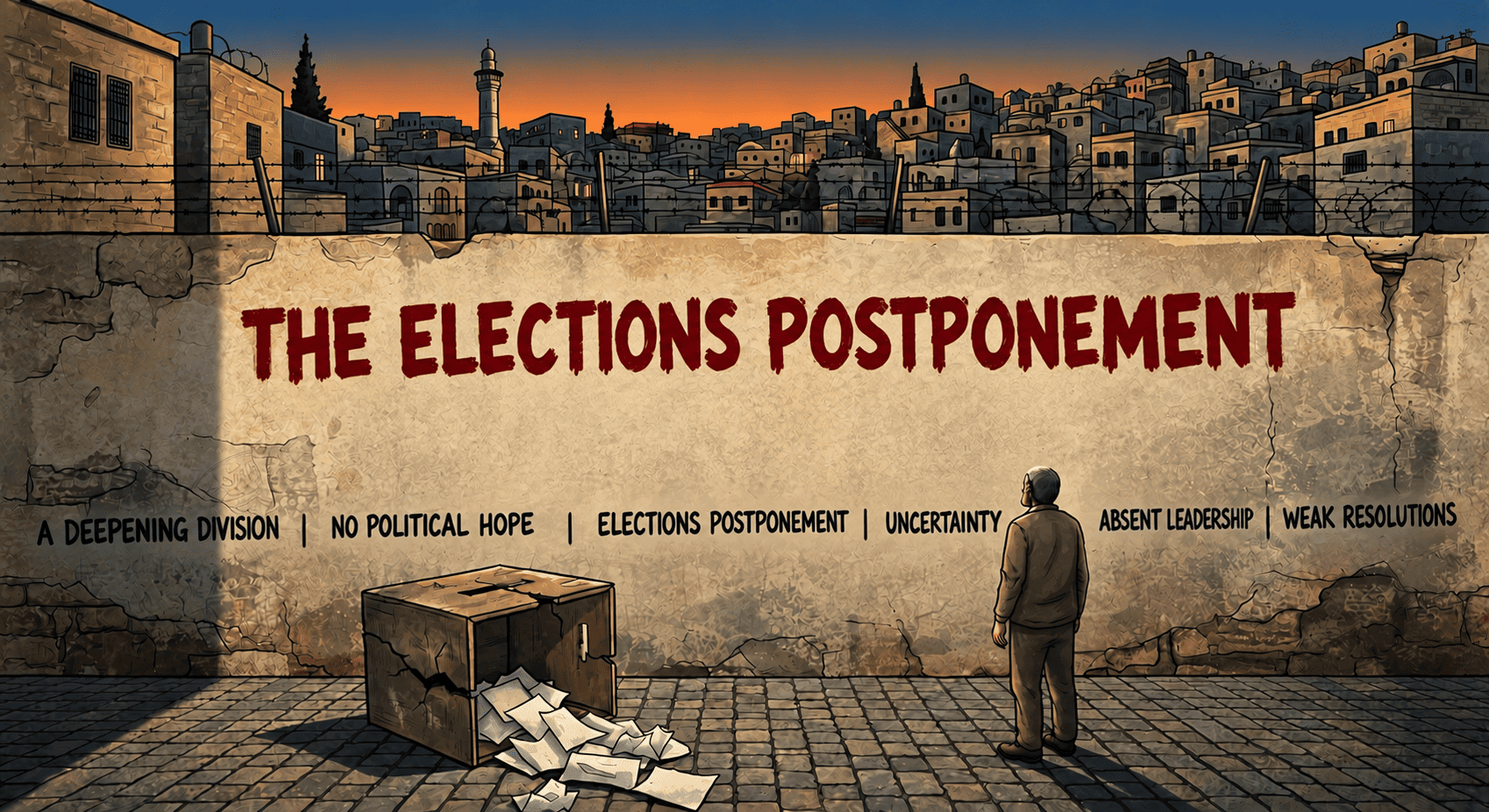

The mistake did not begin with the postponement of the elections, but much earlier: with the decision to call them without securing even the minimum conditions necessary for free and fair elections whose results would be respected. The postponement itself was another failure, as it was not accompanied by a firm commitment to a national rescue plan setting a new election date within a binding national pact. Such a pact, Al-Masri argues, must require all parties to accept the results and abide by the rules of united-front politics, a framework suited to any national liberation movement.
The deeper problem, he maintains, lies in the continued absence of a clear vision, a coherent strategy, and unified leadership, as well as in treating elections as though they were a solution in themselves or a magic wand capable of transforming reality. Elections alone cannot bring about change, even in independent, sovereign states, let alone under occupation.
Without forces capable of driving change, there can be no change. Just as there can be no democracy without democrats or revolution without revolutionaries, Al-Masri argues, the greatest deficiency is the absence of credible national and revolutionary forces with real weight, forces that stand apart from the existing order and offer a genuine alternative.
The task, therefore, is to think and act to bring such forces into being. The moment is opportune, he suggests, as growing segments of society are becoming ready for change. Many are searching for a new national and democratic alternative, while others seek little more than a change of faces, some of whom may prove no better than those currently in power.
Why Were the Elections Postponed?
At a deeper level, Al-Masri traces the postponement to several interrelated factors. First and foremost is the Israeli occupation, which intervenes at every stage of the electoral process to influence it or invalidate its results. Second is the Palestinian division and the absence of national consensus on how the elections should be conducted.
Any competition, whether political, sporting, or otherwise, requires prior agreement on its rules and procedures. That is true under normal circumstances; how much more essential is it in the exceptional Palestinian reality, where all forms of political legitimacy have been eroded? In such circumstances, Al-Masri argues, it is unacceptable for the president to act as though he possesses the full range of powers normally associated with the office of a president in a sovereign state.
The postponement, he argues, was also rooted in the president’s unilateral decision-making and his apparent concern, following opinion polls and the emergence of some electoral lists, that the election could result in a loss. It also reflected the failure to adopt new strategies to replace those that had reached a dead end, alongside urgent priorities demanding immediate attention: the house is on fire, and putting out the flames must come first.
Other contributing factors included the leadership’s and factions’ lack of preparedness for elections, or for other political challenges, the chaos within Fatah, and the movement’s failure to maintain internal unity.
In Al-Masri’s assessment, the postponement was written on the wall for anyone willing to see it. From the outset, there were signs that the intention was to avoid holding the elections.
The Warning Signs Were There from the Beginning
Al-Masri points to a range of justifications, political calculations, and procedural decisions that, in his view, indicated the elections were unlikely to proceed.
Some of the arguments cited were serious and grounded in the realities on the ground, including the ongoing genocide, displacement, annexation, and apartheid; escalating Israeli military aggression and settlement expansion; attacks by settlers and occupation forces; and deliberate efforts to weaken and undermine the Palestinian Authority. These efforts, he argues, aim either to hollow out the Authority further or dismantle it, disarm it, and replace it with local authorities dependent on Israel. He also raises the possibility of extending to the West Bank the experience of the so-called “Board of Peace,” which he describes as a trusteeship imposed under the guise of peace.
Al-Masri also points to Israel’s opposition to the elections on numerous grounds, including the direct or indirect participation of Hamas. He further argues that the Trump administration opposed the elections, citing its failure to respond to a question from the Palestinian Authority, a silence he interprets as an answer in itself. In his view, an elected Palestinian Legislative Council would create a duality of authority and political reference between the council and the “Board of Peace.” He notes that Mladenov expressed this opposition during a meeting with Palestinian representatives.
At the same time, Al-Masri argues, flimsy pretexts were invoked, including the question of holding elections in Jerusalem. Yet alternatives could have been found had the political will existed.
A Series of Decisions That Pointed Toward Postponement
For Al-Masri, the warning signs were also evident in the shifting plans and decisions surrounding the electoral process.
The process initially involved calls for elections to the Palestinian National Council, through which the president would be elected. That proposal was subsequently abandoned following external pressure. The plan then shifted to a Legislative Council of 200 members, before the number was reduced to 132, with 68 members from the West Bank and Gaza Strip to be appointed rather than elected.
The choice of an unsuitable election date was another indication. Proposals to delay the elections until the composition of the new Israeli government, the outcome of the US elections, and the future of the aggression against Iran became clearer were rejected. Holding the elections while Netanyahu remained in office, even if his government were to lose, suggested, in Al-Masri’s interpretation, that the timing was based on the expectation of an inevitable Israeli refusal, which could then be used to justify postponement.
He also criticizes the restrictions imposed on candidates, including the requirement to commit to the Palestine Liberation Organization’s political program. Such a condition, he argues, strikes at the heart of the electoral process: elections should be a competition between political programs, but this requirement turns them into a contest over positions and interests.
The confusion and improvisation surrounding electoral procedures and legislation further undermined the process. Al-Masri cites the allocation of seats for Christians, what he calls the “theatre” of electoral constituencies, and the lowering of the electoral threshold, which, in his view, effectively turns general elections into local ones.
He also points to the Palestinian Authority’s rejection of Hamas’s participation on the grounds that the movement is unacceptable internationally and to Israel, alongside Israeli threats to target Hamas and other resistance factions through arrests and assassinations should they take part in the elections.
What kind of democratic elections can be held when major political factions are barred from participating? For Al-Masri, this question alone underscores the need for national consensus on how to confront Israeli interference and attacks intended to prevent elections from taking place or invalidate their results.
Was the Postponement Really the Result of an Initiative?
In light of all these factors, Al-Masri poses a fundamental question: can the postponement be explained simply by the Popular Front’s initiative and the recommendation of the factions that met in Cairo? Or were the initiative and recommendation merely used as a convenient way out, a pretext for postponement rather than its true cause?
He raises a second question concerning the widespread belief that elections are imposed by the international community. Should Palestinians continue to rely on this assumption, or should they recognize that no one is paying them the attention they need and that they must identify their own interests?
For Al-Masri, those interests lie in building an effective political system and establishing credible, legitimate, and pluralistic leadership. Neither can emerge in isolation. Both must be rooted in a national project built on three essential pillars: national consensus, a shared national program, and elections.
To be continued.
Note: This is not a literal, word by word translation of the original article. It is an English adaptation that conveys all of the original article’s ideas and follows its argument and sequence. Direct quotations are taken from the original article.